Wednesday, October 28, 2009

Two Russian Cameras…Two Rolls of Film…

I recently loaded two rolls of cheapo (and expired by over three years) Fuji 100 film into two of my Russian cameras.  One roll went into the Horizon 202 (the Widelux clone) and one went into the Zenit 122.  

Untitled-51The old train car behind the Square.  Shot with the Zenit and the Helios 44-2.

Helios and Industar:

On the Zenit, I used the legendary Helios 44-2 lens for some of the images and the diminutive Industar 50-2 lens for the rest.  Both have rare earth glass and are mildly radioactive.  (The Russians had a strange numbering system for their lenses since the Helios was not a 44mm f/2 and the Industar was not a 50mm f/2.)

The Photos:

The photos here were shot over a period of about two weeks, and the film was developed in my kitchen on 10-27-09.  I scanned the film on an Epson 4490 film scanner.  These were all shot on film!

Untitled-4Antique shop on the Square.  Lots of “guy” stuff in there.

Untitled-3The statue of Alexander Clay is always a willing and unwavering model for my camera and film testing.

Expired Film…Expired Chemistry…

In keeping with the Russian theme of git-er-done with watcha got, my C41 color film developing chemicals reached two years old this month.  According to the documentation, the chemistry should have been good for about three months or six rolls of film:  whichever came first.  At $14 for the entire kit of chemicals, it was a bargain since Wolf Camera was charging $4 per roll to develop just  negatives.   Now, two years later and about twenty-four rolls of film successfully developed, I have really gotten my money’s worth!  And the chemistry doesn’t seem to be diminishing that much.

Untitled-1Cool Beans. 

Untitled-6Eddie’s Trick Shop.

Untitled-2In an alley by the Square.  This is a straight wall, but it is distorted by the swing-lens of the Horizon 202.

Untitled-13A seafood restaurant on Canton Road.  Looks like the Dolphins are jumping into the wires that look like nets.

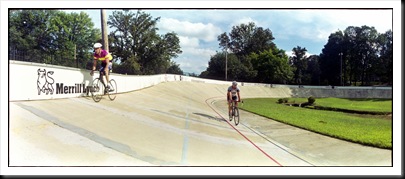
Untitled-7An early autumn afternoon at Dick Lane Velodrome, East Point, Atlanta, Georgia.

Untitled-12 One speed.  No brakes.  A workout at the velodrome with my friends.

Untitled-21My friend, Todd Kaminski, shot this photo of me at the velodrome using my Horizon 202 camera.  Of course, we all agreed not to run over him while he sat in the middle of the track on the back straight.

Untitled-10Untitled-22


You can see that even the straightaways are angled at 10 degrees.  The curves are banked at about 40 degrees.

The Zenit 122 Russian Plastic SLR: 

Untitled-32

My church, Eastminster Presbyterian, shot on film with the Zenit 122.  Last Sunday, I shot some digital images for the church’s website.  It was Reformation Sunday, and it was celebrated by the Kirkin’ O’the Tartans.  I wish I had shot film of that instead of digital.

http://s158.photobucket.com/albums/t96/pmorrissey1/Kirkin%20O%20the%20Tartans/

Untitled-49My Gios Torino Super Record.  Shot with the Zenit and the Industar 50-2.

Untitled-61b

Shot with the Zenit and the Helios.  I used an old Vivitar flash pointed at the ceiling.

Untitled-60

Shot with the Zenit and the Helios lens with an old  Vivitar flash pointed at the ceiling.  My uncle Harold gave me this old Kodak folding camera.

Thoughts…

In many ways, film is superior to digital.  I seem to have adopted what they call a “Figital” workflow.  Shooting film and then scanning it into digital.  In many ways, there’s a quality that can’t be achieved in a pure digital workflow.

More to come….

Friday, October 16, 2009

High Dynamic Range (HDR) Photography

I recently set out on photo safari to experiment with HDR photography.  HDR photography is used to create a higher dynamic range than can be achieved  in a single exposure of film or digital.  With HDR, detail can be seen in areas that are usually too dark or too light to show up in a typical photograph.  The resulting HDR photograph looks more like the way our eyes might see it.

HDR is done by taking at least three images of the exact same scene at different exposures and then overlaying them to create a single image.

The images here were taken between 7:30 pm and 9:00 pm on October 15th, 2009 at the Square in Marietta, Georgia.  The equipment I used was a Nikon D100 with a 30-year old Nikon E-Series 28mm f/2.8 lens.  I used my old Tiltall tripod.

Blog 1

I only used three separate exposures to create each of these HDR images.  One image is shot at the correct exposure, one at two stops under, and one at two stops over.  I used the Essential HDR freeware to process these images.

DSC_7853 DSC_7854  DSC_7855

Exposure for the three images above (from left to right) was ISO 200, f/8 at 1/4 second, 1-second, and 4-seconds.

The mistake that most photographers seem to make when using HDR is taking the effect way too far past reality.  As you can see from the HDR Group on Flickr, http://www.flickr.com/groups/hdr/, some images can come out very fake looking so they don’t look like real photographs anymore.  The goal of HDR is to create an image that looks more like what you saw instead of the way photographs usually look.

Blog 3

One difficulty (or advantage, depending on how you look at it) of night time HDR photography is that people and moving cars almost disappear.  This scene above had about 20 people walking across the street on the other side from left to right.

Blog 7

During this series of exposures in front of the window at Eddie’s Trick Shop, an entire family including a lady pushing a stroller walked between me and the window.  You can see a faint ghost trail.

Blog 6

DSC_7805DSC_7806DSC_7807

The image above is uninteresting, but it shows the power of HDR.  The image in the center of the three images above would be closest to the “correct” exposure for a single image.  You can see that the brick wall to the left is faded into darkness, and the “Cool Beans” sign is very over exposed.  Combining the three images brought out the detail in the dark areas and brought down the overexposed highlights in the sign.

 blog 4

Sequence: {DSC_7823.JPG: TV=0.076923, AV=1.0, Bias=0.0} {DSC_7824.JPG: TV=0.333333, AV=1.0, Bias=0.0} {DSC_7825.JPG: TV=1.300000, AV=1.0, Bias=0.0}

Ballet school.  The girls managed to stand still long enough to show up in the photo.  I wanted to get more exposures of this scene, but I was worried that people would think I was a creep taking photos of little ballerinas with a camera on a tripod.

blog 2

Edgar Allen Scarecrow.

DSC_7829_to_7831_JPG

The scene above had a group of about 25 people walking through during the exposures.  Outdoor dining at Hemingway’s pub.

Next Steps

I’m going to try some daylight HDR.   Shorter exposures typically used in daylight will keep people from evaporating.  It might be an interesting effect to see some pedestrians showing up three times in one HDR photo.

Some Really Good HDR Photographers

Some skilled photographers such as Jeffrey Jacobs are using HDR in commercial photography without going over the line into fakey.  Some of his images are actually multiple exposures shot on one frame of film.  Here are links to some professionals using HDR in an effective way.

Here are some links to some realistic HDR images.

Jeffrey Jacobs:  http://www.jeffreyjacobsphoto.com/home.asp

Colby Brown: http://www.colbybrownphotography.com/portfolio/high-dynamic-range-%28hdr%29_9.html

A random good example of HDR technique:

http://www.flickr.com/photos/dcdead/3713208200/sizes/o/

A random really bad example of HDR technique:

http://www.flickr.com/photos/kros/219085067/

Monday, September 7, 2009

WideLux


One of the challenges of photography (at least for me) is staying fresh and continuing to evolve. Since I have been practicing photography since about 1975, that’s quite a challenge for me.

One interesting insight that I have is enjoying the amalgam of photography and bicycle racing. Both cyclists and photographers have a fascination with equipment. Anybody can purchase the highest level of equipment, but few can exploit the full potential of that equipment. Few can make a photograph like Henri Cartier Bresson, and few can win races like Eddy Merckx did.


It has often been said that the best at any endeavor can excel with only the minimum of equipment. The state of the art is not required for some. But for me, I have found that hardware is sometimes essential for breaking through an emotional or creative barrier that had been holding me back in either photography and cycling.

One good example of this is my Horizon 202 camera. A Russian-made camera that emulates the Widelux.

I became fascinated with the Widelux about 20 years ago when I stumbled upon it in a magazine article. At around $2,000, it was beyond my reach for just a simple camera. But I was able to rent one for 3-days from PPR (Professional Photographic Resources) in midtown Atlanta. I shot a few rolls of film, and resigned myself to the idea that such a specialty camera didn’t warrant more money than I had ever spent on a camera before.

But, in 2003, I found about a Russian copy of the camera. I wouldn’t call it a clone because it didn’t have the same DNA. But it could do the same thing in the same fashion. And it was only $240.


More recently, I was inspired by the work of Jeff Bridges. Yes, the actor. He has been carrying around his Widelux for decades, and has compiled a large body of work with it. You can see some examples on his website.

http://jeffbridges.com/moguls_cover.html


Since I acquired the Horizon 202, I have had mixed success with it. The camera is so unusual that people are intrigued and curious to the point that they are caught off-guard. It causes people in proximity to alter their behavior so that the observer affects the observed.

But today, Labor Day 2009, I took it with me to a professional bicycle race, and transcended my capabilities. The camera allowed me to break free from my limitations and capture images that I would not have been able to capture with common equipment.

I think that these are some of my finest Widelux images yet. The Horizon 202 allows me to make good mistakes that my otherwise structured thinking won’t allow.


Friday, July 3, 2009

Photo Safari 7-3-09

The challenge in a photo safari is having a total lack of defined subject or specific event that may generate an “easy” subject. 

I set out today with a Kowa Six medium format and a Nikon D1h with a Lensbaby and a destroyed Pentax screw-mount lens that somebody had thrown in the garbage.  The reason somebody had tossed this 200mm f/2.8 was because it was stuck open at f/2.8.  Not too much of a problem for a Nikon that can exceed 1/10,000 of a second.  Far faster than an old Pentax.

DSC_3685c 

Image above is from the trashed Pentax lens on the Nikon D1h.

DSC_3696b

The image above is the Nikon D1h with the Lensbaby.

Untitled-2

The image above is the 1979 Kowa Six 85mm f/2.8.

In the Kowa, I used Arista Ultra 400 that I souped in the kitchen this evening in Tmax developer at 22C for about 8 minutes with a 5-minute pre-soak in Cobb County tap water.  Then I scanned the film using an Epson 4490 film scanner.

DSC_3748b

Lensbaby

DSC_3747b

Lensbaby

Untitled-1

Image above is from the Kowa Six.

Still reacquainting myself with the old Kowa.  (Better images to come from this old camera.)  The bokeh of the Kowa lens is just amazing!  Look at the softness of the blurred background.  1970’'s medium format cameras have a lens and film resolution equal to better than 40 megapixel digital.  Yes, I said “forty.”

DSCF2738b 

Fuji F50fd

Also, I have a small Fujifilm F50FD that I use like a polaroid/light-meter when I’m shooting film.  I set it on manual and see what exposure works, and then I use that exposure on the film camera.   I was shooting from the hip to check the light, and this image was in the camera. 

Wednesday, July 1, 2009

Dick Lane Velodrome, July 11th.

Coming up on Saturday, July 11th is an evening of professional bicycle racing at the Dick Lane Velodrome in Atlanta.

Starts at 6:00 pm, (usually finishes around nine or nine-thirty) and now there’s beer!

http://hosted.verticalresponse.com/360532/20d5540277/TEST/TEST/

Here’s a link to the info:

http://www.dicklanevelodrome.com/system/files/09thewheelraceflier.pdf

If you have never been, you really should take the time to come out and see some elite athletes compete on a 321-meter steeply banked track. 

 DSC_2984-01b Velo 2b

The Keirin

Velo 5

The Kerin sprint final

DSC_2922-01b

Points Race.

DSC_2908-01b


All photos copyright Phillip Morrissey 2009.

Creative Commons License
This work is licensed under a Creative Commons Attribution-Noncommercial-No Derivative Works 3.0 United States License.